The P vs NP Problem
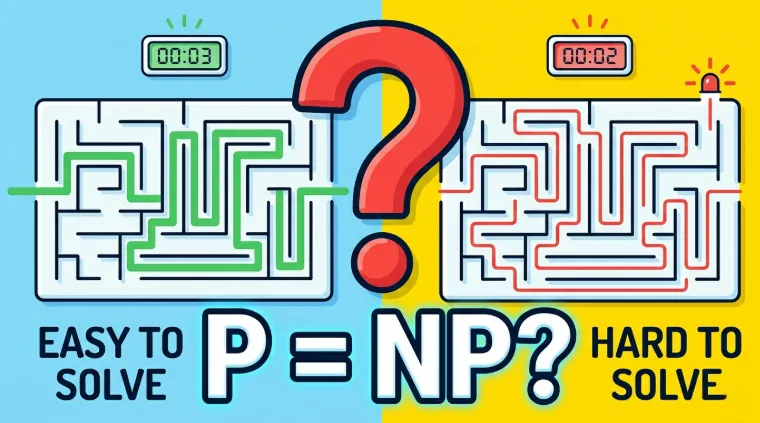
The P vs NP problem is widely considered the most important open question in computer science. At its core, it asks whether every problem whose solution can be checked quickly can also be solved quickly. This question sounds simple, but it captures a deep issue about the nature of computation and efficiency.
Contents
The P vs NP problem is widely considered the most important open question in computer science. At its core, it asks whether every problem whose solution can be checked quickly can also be solved quickly. This question sounds simple, but it captures a deep issue about the nature of computation and efficiency. Since it was formally introduced in 1971, no one has been able to prove the answer, despite decades of effort and a one million dollar prize offered by the Clay Mathematics Institute.
The Idea of Efficient Computation
To understand the problem, it helps to think about what it means for an algorithm to be efficient. Some problems scale in a manageable way as input size grows. For example, sorting a list of numbers becomes slower as the list gets longer, but the increase in time follows a predictable pattern. These problems are grouped into a class called P. They represent tasks that computers can solve in a reasonable amount of time, even for large inputs.
The key characteristic of problems in P is that their running time grows polynomially. This means that if the input becomes ten times larger, the computation might take ten or one hundred times longer, but not an astronomical amount more. These are the kinds of problems that form the foundation of everyday computing.
When Verification Is Easy but Solving Is Hard
There is another class of problems called NP that introduces a subtle but important difference. For these problems, if someone gives you a candidate solution, you can check whether it is correct quickly. However, finding that solution from scratch can be extremely difficult.
A simple example is a Sudoku puzzle. Given a completed grid, it is easy to verify whether all the rules are satisfied. However, solving the puzzle from an empty grid may require exploring many possibilities. This gap between verification and discovery appears in many important computational problems.
Another example comes from number theory. Multiplying two prime numbers is straightforward, even when the numbers are large. However, if you are given the result and asked to find the original primes, the task becomes much harder. This asymmetry is what makes modern cryptographic systems possible, since they rely on problems that are easy to check but hard to reverse.
The Hardest Problems in NP
Within NP, there is a special group known as NP-complete problems. These are considered the most difficult problems in the class. What makes them remarkable is that they are all connected through reductions. If one of these problems can be solved efficiently, then every problem in NP can also be solved efficiently.
One of the first problems shown to have this property is the Boolean satisfiability problem. It asks whether there exists an assignment of true and false values that makes a logical expression evaluate to true. Many other problems fall into this category, including the traveling salesman problem, scheduling tasks, and various optimization challenges.
These problems show up in real-world applications such as logistics, circuit design, and computational biology. Despite their importance, no efficient algorithm is known for solving them in all cases.
Why the Question Matters
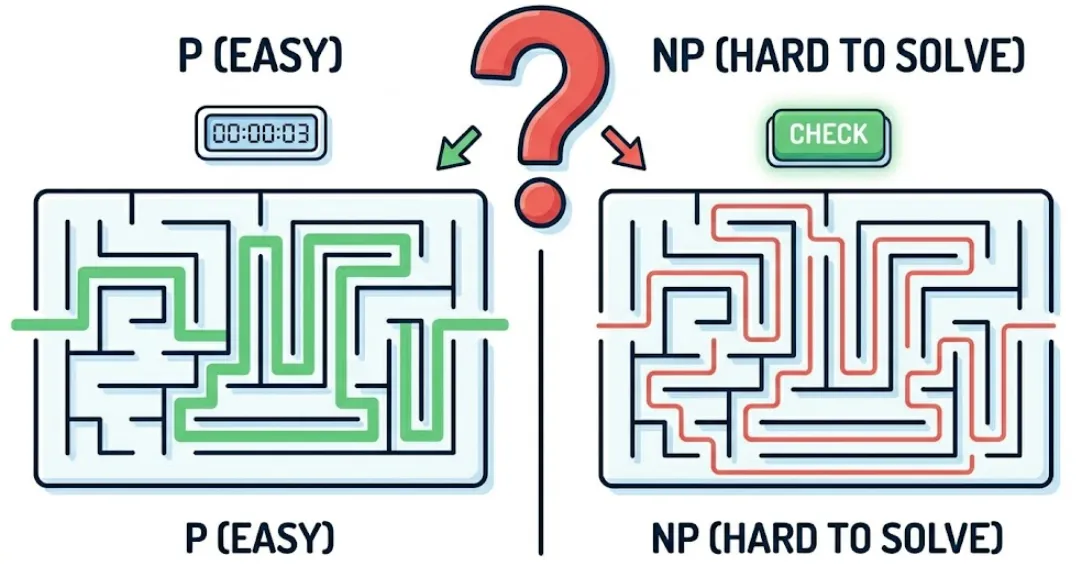
The significance of the P vs NP problem lies in its consequences. If it turns out that P equals NP, then many problems that are currently considered intractable would suddenly become efficiently solvable. This could lead to major advances in science and engineering, including better optimization, faster drug discovery, and improved artificial intelligence systems.
At the same time, such a result would have serious downsides. Many cryptographic systems depend on the assumption that certain problems are hard to solve. If those problems become easy, then current methods of securing data, communication, and financial systems could break down.
If P does not equal NP, it would confirm that some problems are inherently difficult. It would mean that no matter how clever our algorithms become, there are limits to what can be computed efficiently. This would reinforce the importance of approximation methods and heuristics in solving real-world problems.
Practical Approaches to Hard Problems
Since many NP problems are believed to be hard, practical systems rarely try to solve them exactly. Instead, they use strategies that produce good enough solutions within a reasonable time. These include approximation algorithms, greedy methods, and local search techniques.
In many applications, finding a perfect solution is less important than finding a solution that works well in practice. This is why industries such as logistics, scheduling, and machine learning rely heavily on heuristics rather than exact algorithms.
Why It Remains Unsolved
Despite its simple formulation, the P vs NP problem has resisted all attempts at a proof. Researchers have identified several barriers that limit the effectiveness of existing techniques. These barriers suggest that solving the problem may require entirely new mathematical ideas.
Over the years, many claimed proofs have been proposed, but none have held up under scrutiny. The difficulty of the problem lies not only in its complexity but also in the fundamental nature of the concepts it involves.
Conclusion
The P vs NP problem is more than just a technical challenge. It represents a deep question about the limits of computation and the structure of problems themselves. It forces us to think about whether difficulty is an inherent property of certain tasks or simply a reflection of our current understanding.
Whether P equals NP or not, the answer will have far-reaching implications for computer science and beyond. Until then, the problem remains open, continuing to challenge and inspire researchers around the world.
Source: Published Notion page
This article
Post Reactions
Join the conversation
Write a Comment
Share your thought about this article.
Comments
Loading comments...