The Physics From 1879 That Could Have Saved Your Controller
The solution to joystick drift has technically existed since 1879. That’s when Edwin Hall discovered that a magnetic field could produce a measurable voltage across a conductor, making it possible to measure position precisely without physical contact, meaning no wear and no drift. Sega actually used this technology in the Dreamcast. But instead of becoming the standard, the industry stuck with cheaper potentiometers. Joystick drift became almost universal, lawsuits followed, and somehow, most flagship controllers still haven’t solved the problem.
Contents
- The Physics From 1879 That Could Have Saved Your Controller
- A Graduate Student in Baltimore
- The Problem That Nobody Thought Was a Problem
- The Industry That Knew and Did Not Fix It
- When the Lawsuits Started
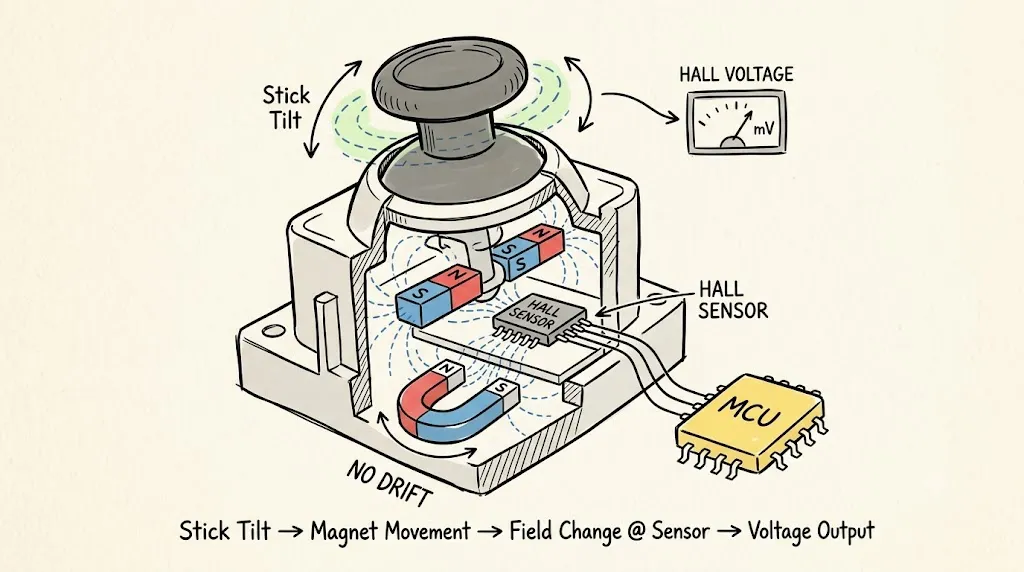
- How Hall Effect Joysticks Actually Work
- The Controllers That Got There First
- Why the Big Three Have Not Moved
- The Gap Between Discovery and Application
The Physics From 1879 That Could Have Saved Your Controller
Your character walks off a cliff. You are not touching the joystick. You set the controller down, come back, and it is still happening. You blow into it, recalibrate it, tape a piece of cardboard under the stick. Nothing works. Eventually you buy a new one and the cycle begins again.
This is stick drift. It has cost players hundreds of millions of dollars in replacement controllers, triggered multiple class-action lawsuits against Nintendo, and become such a universal experience that entire subreddits are dedicated to coping with it. And the frustrating part, the thing that makes it genuinely hard to accept, is that the solution has existed since 1879.
A Graduate Student in Baltimore
On an autumn day in 1879, Edwin Hall was at his bench in Johns Hopkins University's physics lab, a converted kitchen off Baltimore's North Howard Street called "the Annex." The third-year graduate student, just 23, had set two electromagnets facing each other and slid a tiny strip of gold foil carrying an electric current in the gap.
He was investigating a question that sounds simple on the surface. When you run an electric current through a conductor sitting inside a magnetic field, does the magnetic force act on the conductor itself, or on the current moving through it? James Clerk Maxwell, the towering figure of electromagnetism at the time, had argued the conductor. Hall had read something that made him think Maxwell might be wrong, and he wanted to find out.
Hall reasoned that if the force was specifically acting on the current, it should crowd current to one side of the wire, producing a small measurable voltage. So he built the apparatus, ran the experiment, and measured exactly that. A voltage perpendicular to both the current and the magnetic field, appearing precisely where his reasoning said it should. Maxwell was wrong. The force acted on the current, not the conductor.
His measurements of the tiny effect produced in the apparatus he used were an experimental tour de force, accomplished 18 years before the electron was discovered and published under the name "On a New Action of the Magnet on Electric Currents."
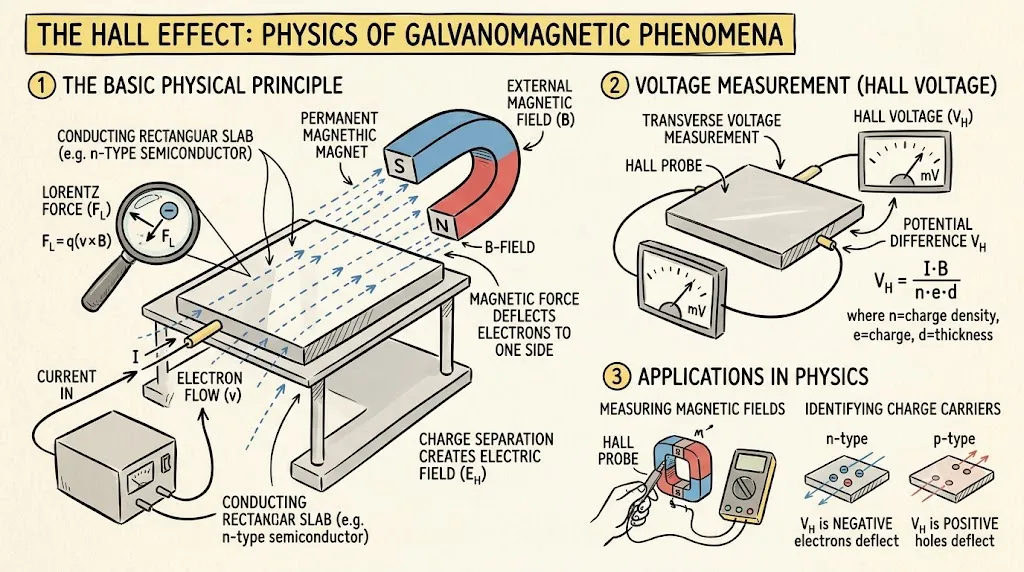
The effect carrying Hall's name is straightforward to describe. Run current through a conductor. Apply a magnetic field perpendicular to that current. The moving charges get deflected sideways by the magnetic force, piling up on one side of the conductor and creating a measurable voltage across it. The strength of that voltage tells you the strength of the magnetic field, and the direction of the deflection tells you the field's orientation. Point a Hall sensor at a magnet and it can tell you exactly where that magnet is and how it is positioned, without touching it, without wearing out, just by measuring voltage.
For most of the century following Hall's discovery, this was a physics phenomenon with industrial applications: speed sensors in cars, proximity detectors in factory equipment, current measurement in power systems. Nobody was thinking about game controllers. The industry that would eventually make Hall sensors a consumer-facing story had not been invented yet.
The Problem That Nobody Thought Was a Problem
When analog joysticks arrived in mainstream gaming in the mid-1990s, the technology underneath them was borrowed from a much older world. Industrial joysticks had been using potentiometers for decades, and they worked well enough for the applications they were designed for. A potentiometer is a resistor with a sliding contact, a wiper, that moves along a resistive track. Move the wiper, change the resistance, change the voltage output. The controller reads that voltage and translates it to a position.
For a joystick, you need two potentiometers, one for each axis. The stick shaft sits in a gimbal and pushes those wipers around as you move it. The resistance changes proportionally to the stick position. The electronics read the voltage, normalize it to a range, and send coordinates to the game.
The whole thing is mechanical contact. The wiper physically rubs against the resistive track every time you move the stick. Every time you dodge in a game, every time you aim, every time you flick the camera, the wiper drags across that track. Under a microscope, you would see graphite or carbon compound wearing away with each pass, tiny particles of debris accumulating in the contact zone, the surface of the track slowly degrading from thousands of repetitive touches.
For a long time this happened slowly enough that it did not matter much. Industrial joysticks get used infrequently by comparison and are built to be serviced. But gaming is not industrial use. A dedicated player might log hundreds of hours on a single game in a few months, spending most of that time with constant stick movement. The potentiometer was never designed to survive that kind of punishment.
The problem arises when these resistive contact pads get worn down over time due to friction. Once the resistance value of the neutral position changes, the controller is reading a different voltage than expected while stationary, and it interprets it as joystick input, resulting in your character slowly walking off that cliff while you get a snack.
That is drift. A voltage that used to mean "center" now means something slightly off-center, and the controller has no way to know the difference. It is not a software bug. It is not a calibration problem. The hardware is degraded and the reading is genuinely wrong.
The Industry That Knew and Did Not Fix It
Engineers knew Hall effect sensors were not as prone to wear and tear as the standard potentiometers. The physics was understood. The technology existed. And remarkably, at least one company actually shipped it.
The Hall effect has been used before in controllers. Specifically, in the SEGA Saturn 3D controller and the SEGA Dreamcast, which both used Hall effect sensors for their analog sticks. Sega's engineers, working in the mid-1990s, chose the contactless solution. The analog stick on those controllers had a magnet on the shaft and a Hall sensor beneath it. Move the stick, move the magnet relative to the sensor, read the changing voltage. No contact. No wear. No drift.
The Dreamcast controller is still remembered and collected today, decades later, and stick drift is not one of the complaints people have about it.
Then Sega left the console market in 2001, and the lesson seemed to go with them. The tech still is not standard controller tech, at least not on the joystick module. Most current-day controllers do use Hall effect tech, but just for reading the trigger buttons. The triggers got the contactless treatment. The sticks, where drift actually happens, kept the potentiometers.
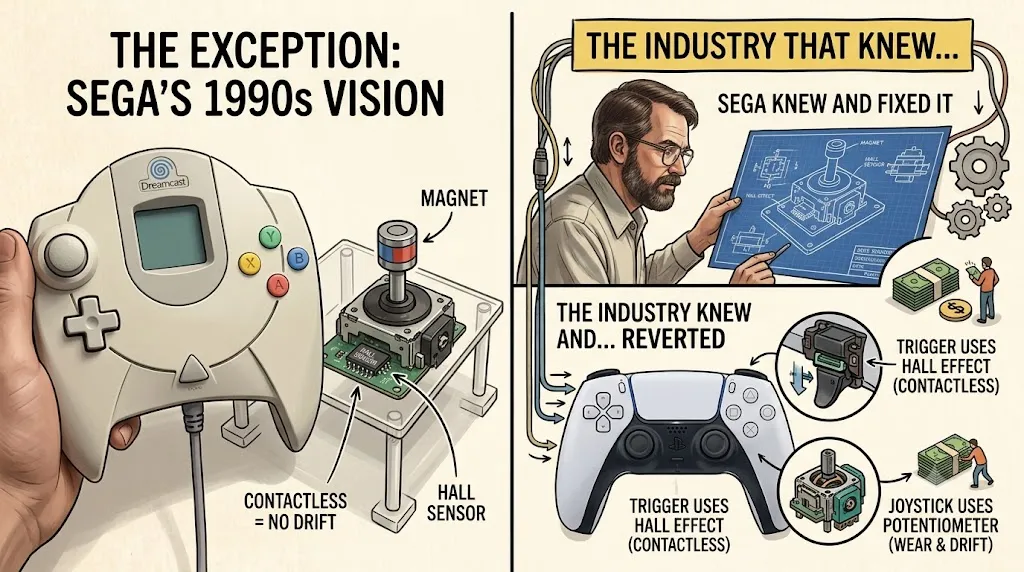
The industry explanation tends to land on cost and size. Hall sensors and the magnet assemblies they require cost more than a simple potentiometer. The Dreamcast controller was criticized for its size, but that size was partially what allowed the Hall effect sensors to be used. As controllers shrunk and margins tightened, the cheaper component won.
That decision has been expensive in a different way.
When the Lawsuits Started
Nintendo launched the Switch in March 2017 with Joy-Con controllers that would become the most talked-about drift problem in gaming history. The Joy-Cons are small, built for portability, and use potentiometer-based sticks with particularly narrow contact areas. They also get used hard, detached and reattached from the console constantly, used in handheld mode where players grip them more tightly.
Among fans of the Switch, the problem became known as "drift." Joy-Cons could quickly wear out in a specific way over the course of ordinary use. By 2019 it had become impossible to ignore. The drifting Joy-Con issue, which causes analogue sticks to register movement even when untouched, was brought to wider public attention with the filing of a US class-action lawsuit in July 2019.
The lawsuit documented the internal structure of a Joy-Con and, per an unnamed technical expert the plaintiffs had consulted, found that drifting was caused by "extensive wear on the pad surface on the interior of the Joy-Con. This transferred debris exacerbates the wear of the pad."
Shortly after the July 2019 class-action lawsuit was filed, Nintendo reportedly stopped charging for repair of drifting Joy-Cons and began refunding those who had already paid for a fix, although it did not acknowledge an actual fault with Switch controllers.
Nintendo's president offered the company's first public Joy-Con drift apology during an investor Q&A in June 2020. Joy-Con drift had spread to enough countries and generated enough legal attention across Europe and North America that silence was no longer tenable. The apology came without any announcement of a fix.
The Switch 2 arrived years later. Its sticks still use potentiometers.
How Hall Effect Joysticks Actually Work
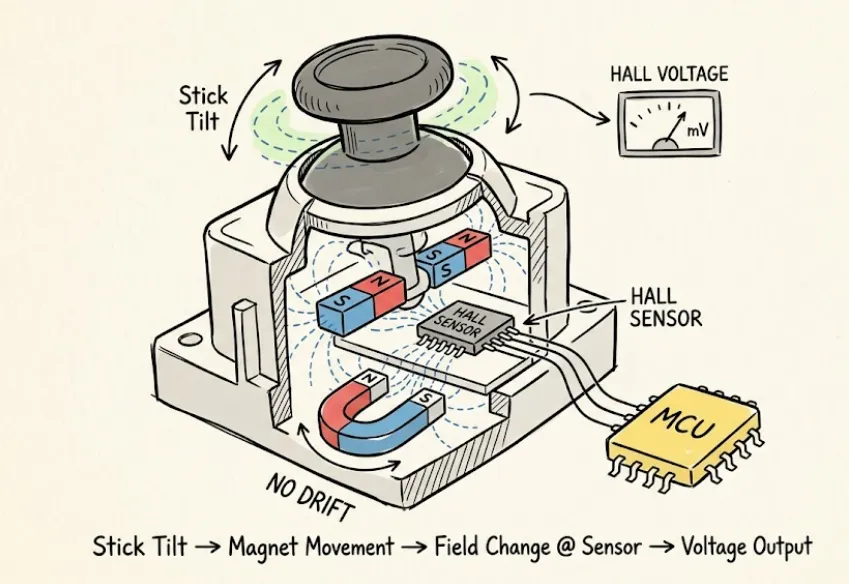
The physics underneath a Hall effect joystick is the same as what Edwin Hall demonstrated with gold foil in 1879, applied to a very specific geometry.
Where the potentiometer joystick uses a resistive pad and wiper to vary the voltage, a Hall effect joystick uses a contactless alternative. The conductive pin is replaced by a magnet, and the resistive contact strip is replaced by a flat conductor sensitive to magnetic fields.
In practice this looks like a small permanent magnet mounted at the base of the joystick shaft, and one or two Hall sensor chips positioned beneath it on the PCB. When the stick is centered, the magnet sits directly above the sensors in a known orientation, producing a known voltage. Move the stick left, the magnet tilts left, the field across the sensor changes, the voltage changes proportionally. The sensor reads that change and reports a position.
The key word is proportionally. A Hall sensor does not snap between states. It reads a continuous analog signal across the full range of motion, giving the same kind of smooth positional data that a potentiometer produces, just without any physical contact between the moving and stationary parts.
Since the Hall effect relies on a magnetic field, none of the components make physical contact, eliminating any source of wear and tear. Hall effect devices are immune to dust, dirt, mud, and water. The magnet does not degrade from movement. The sensor does not wear. The neutral position voltage stays stable because nothing has changed at the hardware level. There is no accumulating debris, no carbon trace wearing away, no threshold creeping in the wrong direction.
A Hall effect joystick could hypothetically last the entire lifetime of the controller, whereas a potentiometer joystick is nearly guaranteed to fail eventually.
The Controllers That Got There First
The mainstream gaming hardware makers have been slow, but the third-party and enthusiast market filled the gap.
GuliKit, a Chinese peripheral maker, was among the first to ship Hall effect sticks in a modern controller at consumer prices. Their King Kong controller line, launched around 2020, became a reference point for what drift-free sticks felt like and helped prove the market existed.
8BitDo followed with their Ultimate Controller line, which includes Hall effect analog sticks across several models at prices competitive with first-party options. The reception was strong enough to push the technology into wider availability.
Handheld PC gaming devices like the Ayaneo and others in that category adopted Hall sensors partly out of necessity. A device that ships without the ability to return it to a manufacturer for warranty repair needs sticks that last. Hall sensors became the responsible choice for that form factor.
The replacement and repair community went further. Custom PCB designs with Hall sensor chips and 3D-printed brackets can replace the potentiometers in a PS4 or Xbox controller, converting existing hardware to the contactless approach. The designs are open and freely shared. For people with the soldering skills to attempt it, it works.
The technology has also pushed into trigger buttons more broadly. The Xbox Elite controller and several competitors use Hall sensors for analog trigger inputs, providing smoother response curves and eliminating the wear patterns that affect analog triggers over time.
Why the Big Three Have Not Moved
The question sitting under all of this is why Sony, Microsoft, and Nintendo have not shipped Hall effect sticks in their flagship controllers, given that the problem is documented, litigated, and widely complained about.
Cost is the honest answer. A Hall sensor assembly costs more than a potentiometer, and controllers are high-volume products with thin margins. The difference is somewhere in the range of a few dollars per unit, which multiplied across tens of millions of controllers becomes a meaningful number on a balance sheet.
There is also a perverse incentive structure. Drift creates replacement purchases. A player whose Joy-Con drifts buys another Joy-Con. That revenue exists because the first controller failed. A controller that lasts indefinitely generates exactly one sale.
None of that is a good engineering reason. It is a business calculation, and players bear the cost of it in frustration and money.
The pressure is building in the right direction. Third-party Hall effect controllers have demonstrated that the market will pay a modest premium for drift-free hardware. Multiple lawsuits have made the legal risk of the status quo more visible. And enough players have learned what Hall sensors are and why they matter that "does it have Hall effect sticks" has become a real purchasing criterion.
The Gap Between Discovery and Application
There is something worth noting about the timeline here. Edwin Hall discovered this effect in 1879 in a converted kitchen in Baltimore, using gold foil and electromagnets. The discovery may be one of the most underappreciated achievements in the history of physics. The principle he demonstrated has since found its way into automotive sensors, medical devices, industrial automation, and dozens of other applications where contactless, reliable position sensing matters.
Game controllers are a late arrival to that list, and an incomplete one. The technology that could have made joystick drift impossible was available long before the first analog stick shipped on a consumer game controller. Sega knew this and built it into the Dreamcast. The rest of the industry looked at the cost difference and chose the cheaper part.
The result is a problem that players have been dealing with for thirty years, that has generated hundreds of millions of dollars in replacement hardware costs, and that remains unresolved in the flagship products of the three largest gaming hardware companies.
Hall's experiment with gold foil took one afternoon. Convincing the gaming industry to use what he found has taken considerably longer.
Source: Published Notion page
This article
Post Reactions
Join the conversation
Write a Comment
Share your thought about this article.
Comments
Loading comments...